Do UV Nail Lamps Damage Your Hands? The Science (2026)
What scientific research says about UV/LED lamps in manicures, the real risks, and how to protect yourself without giving up gel.
The FDA classifies UV/LED nail lamps as "low risk" when used correctly. A 2023 UCSD study showed cellular damage in human cells after 20 minutes of exposure, but it's not proof of cancer in humans — long-term epidemiological research is still needed. Dermatologists agree: use UV gloves or SPF 30+ sunscreen, and you can continue enjoying your gel nails without fear.
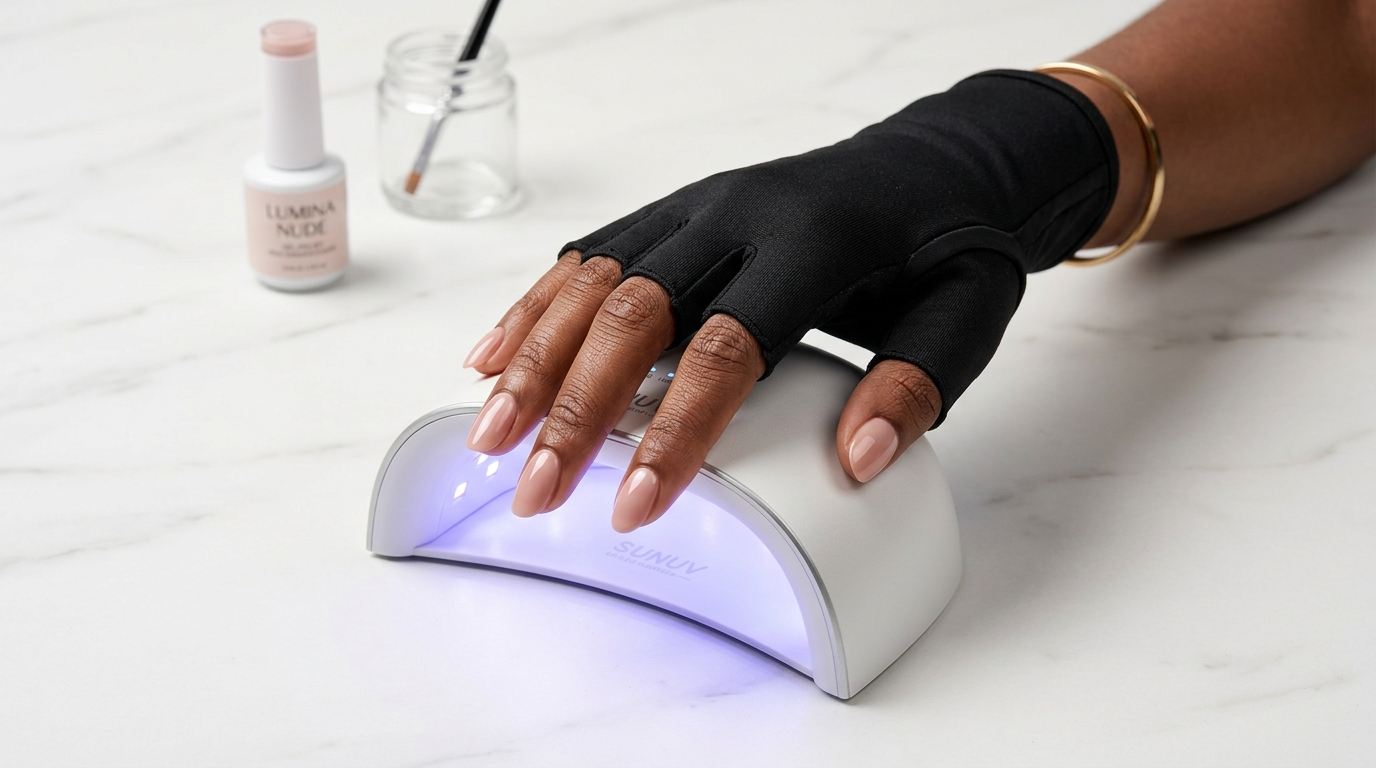
If you've had gel nails more than three times, you've probably seen the headline: "UV nail lamps can cause cancer." You saw it on Instagram, on TikTok, or maybe your mom sent it to you on WhatsApp.
The reality is more nuanced than the headline. There's real scientific research, there's an official FDA position, and there are clear recommendations from dermatologists. Here, we explain what the evidence says — without alarmism and without minimizing — so you can make an informed decision.
- The FDA classifies UV/LED nail lamps as low-risk devices when used according to instructions
- The UCSD study (Nature Communications, January 2023) found 20-30% cell death after a 20-minute session in human cells in a laboratory setting
- A long-term epidemiological study has not yet been conducted — there is no direct proof of increased cancer in humans from normal use
- LED lamps emit less UV-A than traditional pure UV lamps
- UV gloves protect ~95% and cost between $40 and $200 MXN
- SPF 30+ sunscreen applied 20 minutes beforehand blocks approximately 50% of UV-A radiation
The Study That Changed the Conversation
In January 2023, researchers at the University of California San Diego published in Nature Communications one of the first serious studies on the effects of nail drying lamps on human cells.
What they found:
- A single 20-minute session caused between 20% and 30% cell death in the three human cell lines studied (keratinocytes, fibroblasts, and melanocytes).
- Three consecutive 20-minute sessions killed between 65% and 70% of the exposed cells.
- The cells that survived showed mitochondrial and DNA damage, and developed mutations with patterns similar to those seen in human skin cancer.
- DNA damage is cumulative — some mutations are not repaired over time.
Sounds terrible. But we need to understand the context.
What the Study DID NOT Prove
- It was not a study on real people — it was cells in Petri dishes.
- It did not demonstrate that manicures cause cancer in humans. That is a conclusion that the lead researcher herself, Maria Zhivagui, explicitly stated would "require a long-term epidemiological study" that does not yet exist.
- The exposure in the study (full 20-minute sessions) is longer than what you receive in a typical manicure (where your hand is under the lamp only during the curing of each layer, usually 30-90 seconds per layer).
The study is important because it is the first mechanistic evidence that damage exists at the cellular level. But translating that to "gel causes cancer" is a leap that science does not yet support.
What the FDA and Dermatologists Say Today
The FDA periodically reviews adverse event reports for UV nail lamps. Their official position is that these devices are "low risk when used according to the label." The Skin Cancer Foundation and the American Academy of Dermatology share this classification, with nuances.
MD Anderson Cancer Center published a guide explaining that the main risk is not the occasional session, but cumulative exposure — that is, getting gel nails every two weeks for years. Dr. Saira George, a dermatologist at MD Anderson, recommends that anyone who regularly gets gel nails should be checked by a certified dermatologist.
Harvard Health has a similar position: LED lamps emit less UV-A than pure UV lamps, and the risk "is low but not zero." They recommend them with protection.
The current medical consensus is: the absolute risk is low, but it exists, and it can be further reduced with simple measures. It's not a time for panic — it's a time to protect yourself.
The Real Risks on an Honest Scale
There are two distinct things that can happen:
- Cosmetic skin damage — spots, fine lines, loss of elasticity. This is what you'll notice before anything else, and it starts with frequent use without protection.
- Risk of skin cancer — theoretical, not yet epidemiologically proven, but biologically plausible according to the UCSD study.
Who Should Be More Concerned
- Occasional user (1 time a month or less): The risk is very low. An occasional session without protection is not cause for alarm, but using SPF beforehand never hurts.
- Regular user (every 2-3 weeks): This is where the serious conversation comes in. If you've been getting gel nails like this for years, it's worth starting to use protection always and asking a dermatologist to check your hands.
- Professional nail techs: Maximum exposure. They cure layers on 30 to 60 hands per week. For them, UV gloves (which they wear when checking curing) and protective screens are work tools, not optional.
How to Protect Yourself Without Giving Up Gel
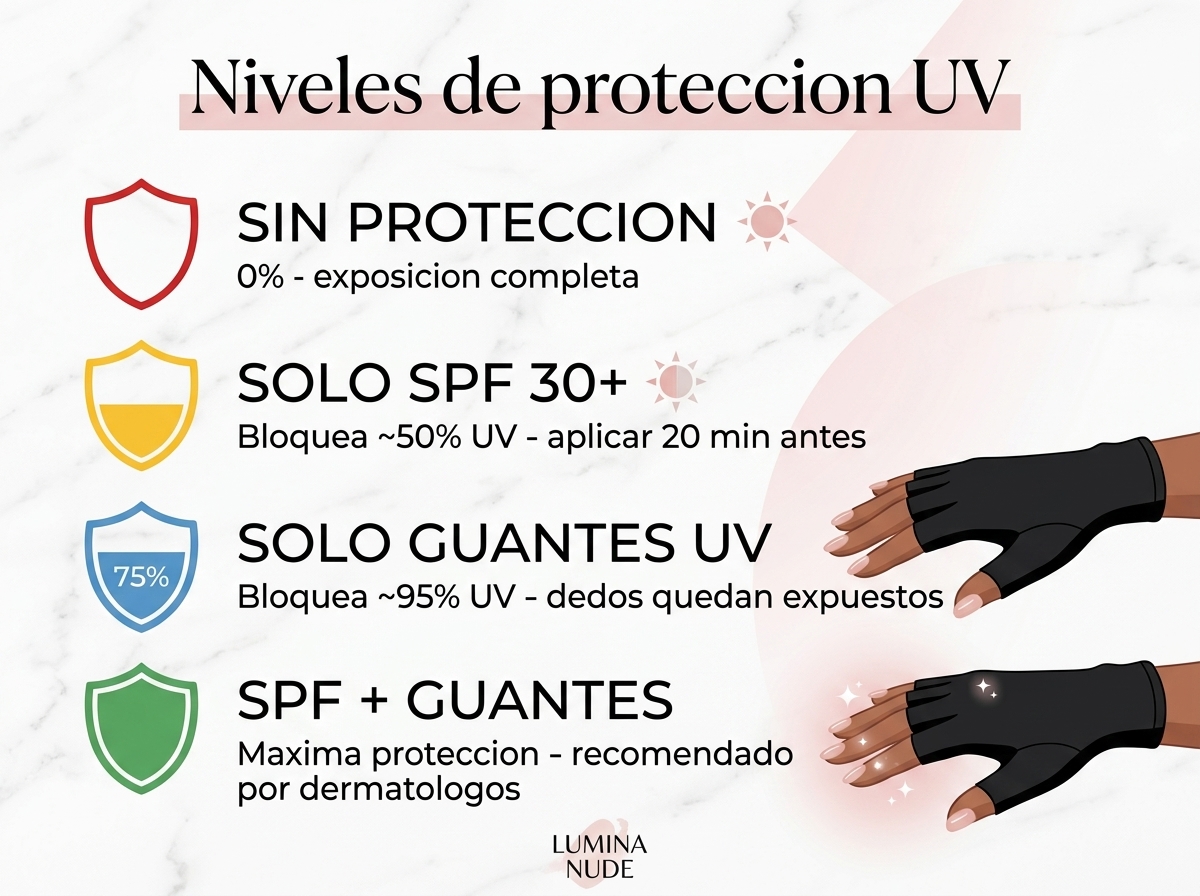
The good news: there are 4 clear levels of protection, all accessible. You can choose one or combine them.
1. UV Gloves with Cut Fingers
This is the most effective option and the one most recommended by dermatologists. They block about 95% of UV-A radiation. They come with fingers exposed up to the first knuckle so your nails still receive the light for curing.
Price: between $40 and $200 MXN on Mercado Libre or professional nail supply stores. A one-time investment.
Cons: the fingertips are still exposed. That's why many dermatologists recommend combining them with SPF on the knuckles.
2. SPF 30+ Sunscreen
Apply it to your hands, fingers, and knuckles 20 minutes before the session. Look for one that says "broad spectrum" — these protect against UVA and UVB. Those with zinc oxide or titanium work best for concentrated lamp UV.
It blocks approximately 50% of UV. Less effective than gloves but better than nothing.
Price: $80-300 MXN for a good face/hand sunscreen.
Cons: you might forget to apply it, or apply it incorrectly (you need enough quantity).
3. LED Lamp Instead of Pure UV
Modern LED lamps emit significantly less UV-A radiation than older fluorescent UV lamps. If you're going to invest in a lamp for home, choose LED or dual UV/LED — they not only protect you more, but they also cure faster.
If you're looking for something occasional and portable, this more economical option is also LED:
4. Space Out Your Manicures
If you get gel nails every week, reduce it to every 2-3 weeks. If you get them every 2 weeks, consider alternating with traditional manicures or press-ons. Cumulative exposure is what matters most — spacing out sessions significantly reduces the total risk.
Myths vs. Reality
Myth: "Gel definitely causes cancer." Reality: It's not proven. There is mechanistic evidence of cellular damage, but no epidemiological studies in humans that demonstrate an increase in cancer from UV manicures with normal use.
Myth: "It's worse than the sun." Reality: It depends. The intensity of UV-A from a nail lamp is more concentrated than the sun, but the duration is much shorter. Total cumulative exposure with weekly use can be comparable to several hours of sun per year.
Myth: "Nail techs have worse hands because of all the UV." Reality: Mixed studies. Some suggest greater skin aging in the hands of nail techs with many years of experience; others find no significant difference when they use protection. Those who take care of themselves look good. Those who don't show signs.
Myth: "If I use SPF under my polish, I'm protected." Reality: No. SPF needs to go on the skin (hands, fingers, knuckles), not under the polish. The nail itself doesn't care about UV; what matters is protecting the surrounding skin.
What We Recommend at Glam Local
If you were talking to a friend, this is what you'd tell them:
- Don't stop getting gel nails just out of fear. Current evidence doesn't justify it.
- Buy some UV gloves. They cost less than $200 MXN and will last you for years. It's the best protection for its price.
- If you get gel nails regularly, put SPF 30+ on your hands every time. Make it automatic.
- If you have a lamp at home, make sure it's LED. If you have an old fluorescent UV lamp, consider replacing it.
- If you've been getting gel nails for years and a dermatologist has never checked your hands, schedule an appointment.
- For some contexts (special events, important photos), you can consider press-ons as a UV-free alternative.